IN APWG’S 20TH ANNIVERSARY YEAR, ECRIME 2023 EXAMINES THE EVOLUTION OF CYBERCRIME IN AN EPOCH OF AI CRIME & ACCELERATING COMPLEXITY
The Symposium on Electronic Crime Research 2023 (eCrime 2023) examines: the emerging tactics, techniques and procedures of today’s threatscape; the economic foundations; behavioral elements; and other keystone aspects that fuel the burgeoning global, multi-billion-dollar cybercrime plexus at its 18th annual symposium on Nov 15 – Nov 17, 2023 in Barcelona, Spain.
APWG sponsoring members can register for NO CHARGE using a members code (i.e. Premium: 3 per; Sponsor: 2 per; Corporate & Corporate Individual levels: 1 per). Member codes will be distributed to APWG members via the members discussion list. Discount ticket codes are also available for unsubsidized university researchers, government personnel and law enforcement personnel. Delegates from those organizations can contact the event organizers at apwg_events@apwg.org.
>Click here< for ecrime 2023 HOTEL ACCOMMODATIONS
APWG will be using this, its 20th anniversary symposium, to map the evolution of cybercrime since 2003 when the first branded phishing campaigns hit bank customers’ email boxes – and to isolate inflection points that present opportunities for programmatic and, hopefully, dispositive interventions. Leading those discussions will be some of the most important authorities in the field of cybercrime suppression and intervention from industry, academia, law enforcement and the public sector. The eCrime 2023 agenda follows, below:
Students requiring discounts should contact symposium managers at apwg_events@apwg.org.
The symposium’s proceedings are in English.
Please contact the APWG eCrime organizers for details via email at apwg_events@apwg.org.
This year’s eCrime program marks 20 years since APWG’s founding. Originally organized by a coalition of banks, technology companies and US federal police agencies investigating the then new threat of phishing, APWG has since evolved into a coalition of cybercrime experts spanning the globe from a number of industries, research disciplines and public-sector entities — from national governments to multilateral treaty organizations.
Celebrating APWG’s 20th Anniversary
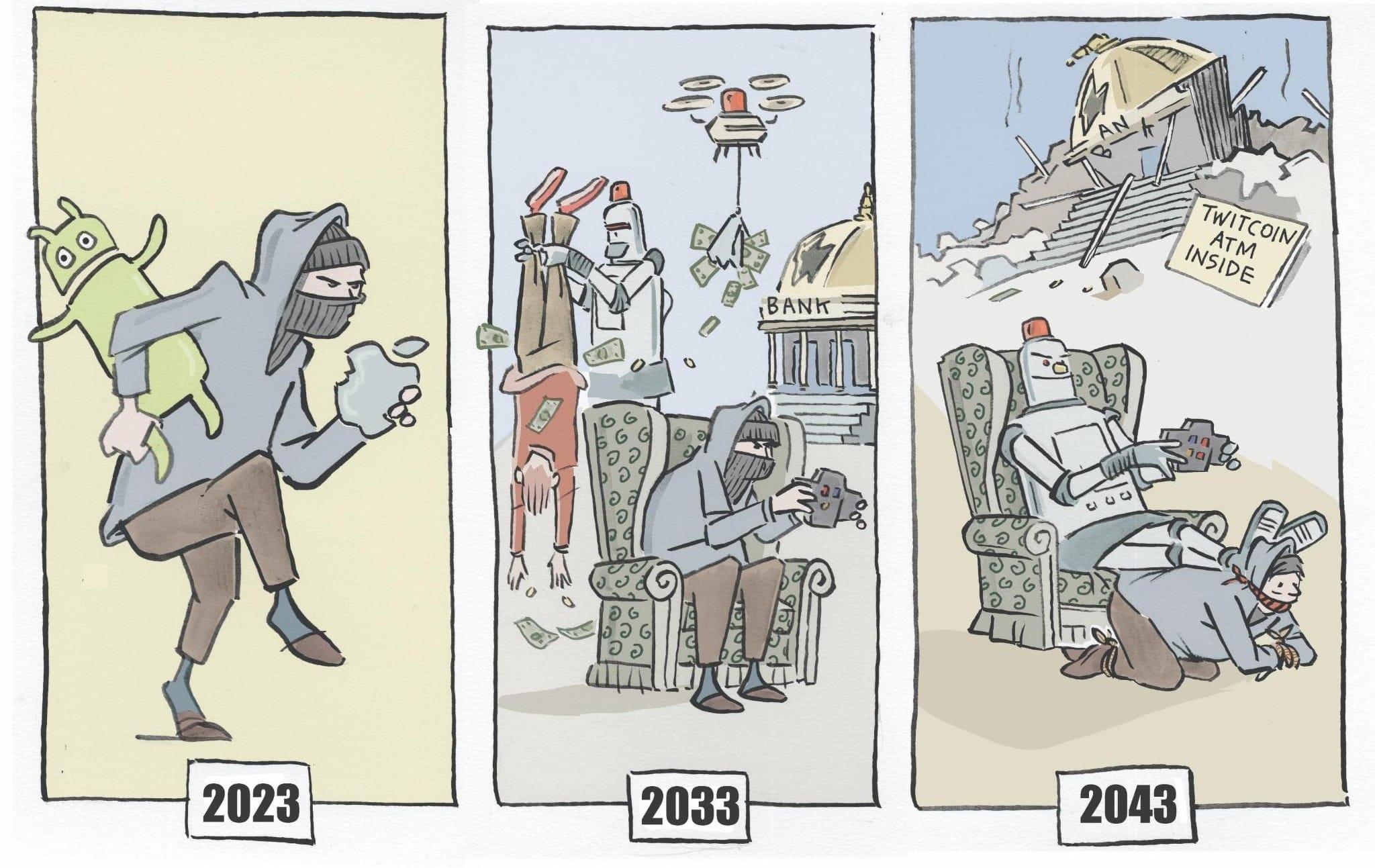
At eCrime 2023, an inter-disciplinary, cross-sector cohort of experts will peer into the future of the global confrontation with cybercrime to map the global response agenda for the decades ahead. Our delegation will consider how cybercrime complexity and AI will influence stake-holders’ strategic direction and define broader imperatives. We will look toward a future in which those synthetic intelligences will be put to use for benefit of civil society, of course, but we will also have to ask, in the end, under whose aegis will these intelligences operate? The good guys’? The bad guys’? Or their own?
AGENDA FOR eCRIME 2023
TUESDAY, NOVEMBER 14
** Times below are CET
| 19:00 – 22:00 | APWG eCrime 2023 Ice Breaker Delegates’ entrance to the restaurant is here: C/ Banys Vells,13 Barcelona 08003 |
 | Ice Breaker Sponsored by Doppel Modern digital risk protection. |
WEDNESDAY, NOVEMBER 15
** Times below are CET
eCrime 2023 Program Sessions and the Confirmed Speakers:
Forging the Responsive Counter-Cybercrime Ecosystem
10 AM
Luis Corrons, Gen Digital — How Generative AI Mutates Phishing and Scam Threats – and What Can Be Done About It
Shawn Loveland, Resecurity — Cutting the Cybergangs Off at the (Evolutionary) Pass
Paul Vixie, Distinguished Engineer, AWS Security — Going Dark: Catastrophic security and privacy losses due to loss of visibility by managed private networks
Brad Wardman, Booz Allen Hamilton — Working Toward Data-Driven Decisions: Reframing applied research to update counter-phishing programs to animate ecosystem-level responses to cybercrime
Achieving High-fidelity Explanations for Risk Exposition Assessment in the Cybersecurity Domain
- Presenter: Albert Calvo (Fundació i2CAT)
- Presenter: Nil Ortiz (Fundació i2CAT)
- Santiago Escuder (Fundació i2CAT)
- Josep Escrig (Fundació i2CAT)
- Xavier Marrugat (Fundació i2CAT)
- Jordi Guijarro (Fundació i2CAT)
Building a Resilient Domain Whitelist to Enhance Phishing Blocklist Accuracy
- Jan Bayer (Université Grenoble Alpes, CNRS, Grenoble INP, LIG)
- Sourena Maroofi (KOR Labs Cybersecurity)
- Olivier Hureau (Université Grenoble Alpes, Grenoble INP, LIG)
- Andrzej Duda (Université Grenoble Alpes, CNRS, Grenoble INP, LIG)
- Maciej Korczyński (Université Grenoble Alpes, CNRS, Grenoble INP, LIG)
Emerging Attack Schemes at the Cybercrime Frontier
Marc Rivero López, Kaspersky Lab / La Salle BCN University – Smart Society Research Group — Prilex Unleashed: The Evolution of Brazil’s Most Notorious Cybercriminal Group
Righard Zwienenberg, ESET / Eddy Willems, WAVCi — Let’s Chat about Gross Public Text generation
Gavin Reid & Joao Santos, Human Security — Deconstructing BADBOX: How HUMAN Detected & Disrupted a Supply Chain Fraud Scheme
Josep Albors, Ontinet / Righard Zwienenberg, ESET — Code Blue: Energy
Challenges to a Global Response to Cybercrime Posed by Complexity of Attack & Obfuscation Architectures
Dr. Laurin Weissinger, Fresenius Digital Technology / Department of Computer Science, Tufts University / Yale Law School
PANEL: Challenges to a Global Response to Cybercrime Posed by Complexity of Attack & Obfuscation Architectures
Panelists:
Richard Clayton, University of Cambridge
Miranda Bruce, University of Oxford
Brad Wardman, Booz Allen Hamilton / APWG
Dr. Serge Droz, Swiss Federal Department of Foreign Affairs / Vice Chair, FIRST
Stephen Cobb, Independent Researcher
THURSDAY, NOVEMBER 16
** Times in CET
Keynote: Chema Alonso, Telefonica
10 AM
Chema Alonso, Telefonica — eCrime 2023 Symposium Keynote
Infrastructure Policy Omissions / Collisions & Litigation as a Policy Instrument
Greg Aaron, Illumintel — DNS and infrastructure policy failures of the last 20 years and what remains to be fixed
Dean Marks, Coalition for Online Accountability — Litigation strategies to discipline platform providers employed by stakeholders in US and Europe
Bobby Flaim, Facebook, Head of Strategic Programs, IP & DNS Legal Team, Meta, Meta’s Adversarial Threat Report: Scoping the Biggest Threats on the Internet
Human Factors in Cybercrime Proliferation & Suppression
Gary Warner, University of Alabama at Birmingham / Dark Tower — Who Will Stand for the (Cyber) Defenseless?
Dr. L. Jean Camp, Indiana University — Baselining Human Resilience at National Scale
Dr. Sanchari Das, University of Denver
PANEL: Empowering Users Through Research-Based Awareness Instrumentation
Panelists:
Dr. Zinaida Benenson, Friedrich-Alexander-Universität
Aimee Larsen-Kirkpatrick, STOP. THINK. CONNECT. Messaging Convention
Samaila Atsen Bako, Cyber Security Experts Association of Nigeria
Dr. Abbie Maroño,Social-Engineer, LLC
Anil Raghuvanshi, ChildSafeNet
Pablo Lopez Aguilar, Global Cyber Alliance
Anil Raghuvanshi, ChildSafe.Net — Generative AI and Child Online Protection
The Slippery Slope: Exploring the Parallels Between Game Cheating and Cybercrime Through Routine Activity Theory
- Selina Cho (University of Oxford)
- Jonathan Lusthaus (University of Oxford)
- Ivan Flechais (University of Oxford)
“Do users fall for real adversarial phishing?” Investigating the human response to evasive webpages
- Ajka Draganovic (University of Liechtenstein)
- Savino Dambra (Norton Research Group)
- Javier Aldana Iuit (Avast Software)
- Kevin Roundy (Norton Research Group)
- Giovanni Apruzzese (University of Liechtenstein)
Hacker’s Paradise: Analysing music in a cybercrime forum
- Anna Talas (University of Cambridge)
- Alice Hutchings (University of Cambridge)
Autism Disclosures and Cybercrime Discourse on a Large Underground Forum
- Jessica Man (University of Cambridge)
- Gilberto Atondo Siu (University of Cambridge)
- Alice Hutchings (University of Cambridge)
FRIDAY, NOVEMBER 17
** Times in CET
Law Enforcement in Cybercrime’s Third Decade as a Growth Industry
Alexander Seger, Executive Secretary of the Cybercrime Convention, Council of Europe — International frameworks for cooperation on cybercrime: Budapest Convention v. UN treaty
Pedro Janices, Ministerio de Seguridad | Argentina — Argentina’s Cybercrime-Fighting Approach: Prosecution – and Prevention
Masayuki Nakajima, National Police Agency Japan — Fighting Fake Stores in Japan (with a review of important aspects of NPA’s cybercrime fighting efforts in Japan.)
A Kubernetes Underlay for OpenTDIP Forensic Computing Backend
- Joey Paquet (Concordia University)
- Serguei Mokhov (Concordia University)
Increasing the Efficiency of Cryptoasset Investigations by Connecting the Cases
- Presenter: Bernhard Haslhofer (Complexity Science Hub Vienna)
- Presenter: Thomas Goger (Bavarian Central Office for the Prosecution of Cybercrime (ZCB))
- Christiane Hanslbauer (Magistrate Court of Bamberg)
- Michael Fröwis (Iknaio Cryptoasset Analytics GmbH)
APWG eCrime eXchange Members’ Review
Pat Cain, APWG — Enhancing the Operational Impact of the APWG eCrime eXchange
Marketplaces & Economics of Cybercrime
Ransomware Economics: A Two-Step Approach To Model Ransom Paid
- Tom Meurs (University of Twente)
- Edward Cartwright (De Montfort University, Leicester)
- Anna Cartwright (Oxford Brookes University, Oxford)
- Marianne Junger (University of Twente)
- Raphael Hoheisel (University of Twente)
- Erik Tews (University of Twente)
- Abhishta Abhishta (University of Twente)
Pump, Dump, and then What? The Long-Term Impact of Cryptocurrency Pump-and-Dump Schemes
- Josh Clough (University of Bristol)
- Matthew Edwards (University of Bristol)
In the market for a Botnet? An in-depth analysis of botnet-related listings on Darkweb marketplaces
- Dimitrios Georgoulias (Aalborg University, Denmark)
- Jens Myrup Pedersen (Aalborg University, Denmark)
- Alice Hutchings (Cambridge University)
- Morten Falch (Aalborg University, Denmark)
- Emmanouil Vasilomanolakis (Technical University of Denmark)
Call For Research Papers
Cybercrime’s Evolution in an Epoch of AI Crime and Accelerating Complexity
APWG celebrates its 20th anniversary by looking ahead to the coming decades that await the larger community of interveners, investigators, policy makers and stakeholders from private and public sectors as they face the increasing challenges posed by AI technologies and the accelerating complexity of the cybercrimes themselves.
APWG eCrime 2023 combines a peer-reviewed conference with general sessions open to industry, government, law enforcement and multilateral organizations, featuring keynote presentations from global thought-leaders, technical and practical sessions, and interactive panels. The objective of eCrime is to foster practical collaboration and the exchange of catalytic ideas by academic researchers, industry security practitioners, and law enforcement professionals in the global struggle against cybercrime.
IMPORTANT DATES:
Full Papers registration and submission due: September 10
Notification of acceptance: October 6
Conference: Nov 15-17
Camera-ready paper due: December 15
Authors of accepted papers must present them and register at the event.
Authors of accepted papers must guarantee that their paper will be presented at the conference. We understand that some authors may face difficulties in obtaining funding to attend the conference. Therefore, a limited number of stipends are available for those who are unable to secure funding. Students who will present their accepted papers themselves will be given priority in receiving such assistance.
eatured Speakers
Paul Vixie
VP and Distinguished Engineer, AWS Security / Director at SIE Europe U.G.
Chema Alonso
Chief Digital Officer, Telefonica.
Dr. L. Jean Camp
Professor, Indiana University
Dean Marks
Director Emeritus and Legal Counsel, Coalition for Online Accountability (“COA”)
View All Confirmed Speakers Here
Call For General Session Talks/Panel Proposals
APWG eCrime 2023 will look ahead at the future of cybercrime in this uniquely perilous hour, when powerful, accessible AI technologies are cheap and ubiquitous and the compound complexities of technologies, (private and public) policies and network topologies make cybercrime fighting more difficult than ever – with no promise of relief on the horizon.
APWG is accepting Session and Panel proposals to complement the Research Papers and complete the eCrime Agenda.
Session and Panel proposals´ topics may include but are not limited to:
- Artificial Intelligence as criminal co-conspirator – and as defensive collaborator
- Addressing challenges of cybercrime’s increasing complexity (e.g. digital infrastructures, crime-fighting/forensic techniques, and the structure of the crimes themselves)
- Detecting and/or mitigating eCrime (e.g. online fraud, malware, phishing, ransomware, etc.)
- Behavioral and psychosocial aspects of cybercrime victimization – and prevention
- Measuring and modeling of cybercrime
- Economics of cybercrime
- Cybercrime payload delivery strategies and countermeasures (e.g. spam, mobile apps, social engineering, etc.)
- Public Policy and Law for cybercrime
- Cryptocurrency and related cybercrimes – and forensic tools and techniques for cryptocurrency related cybercrimes
- Case studies of current cybercrime attack methods, (e.g. phishing, malware, rogue antivirus programs, pharming, crimeware, botnets, and emerging techniques)
- Detecting/preventing abuse of internet infrastructure to neutralize cybercrimes
- Detecting/isolating cybercrime gangs’ and attendant money laundering enterprises
- Cybercrime’s evolution in specific verticals: (e.g. financial services, e-commerce, health, energy & supplies)
- Cybercriminal cloaking techniques – and counter-cloaking tools and approaches
- Design and evaluation of UI/UXs to neutralize fraud and enhance user security
To Submit a session or panel proposal
For consideration please submit a one page abstract abstract to apwg_events@apwg.org with the subject line “eCrime 2023 Session/Panel Proposal” Include speaker(s) name, affiliation and contact details with your submission. Sample slides or other supporting material are welcome.



SPONSORS